
Monotropism Questionnaire
About the Monotropism Questionnaire
The Monotropism[1] Questionnaire[2][3] explores how your attention and interests naturally organise themselves. It looks at how focus, routines, environments, and areas of deep interest shape everyday experience.
Higher scores suggest a more monotropic attention style, where focus tends to gather deeply around one area at a time, often supporting immersion, flow, and intensity[4]. Lower scores suggest a more polytropic attention style, where attention may move more fluidly between multiple areas.
Neither style is better or worse. They reflect different patterns of attention, each with their own strengths, challenges, and environmental needs. It has been shown in the research[5][6] that Autistic and ADHD people often score higher on the Monotropism Questionnaire; however, this is not a specific Autism or ADHD test.
About the Structure of the Questionnaire
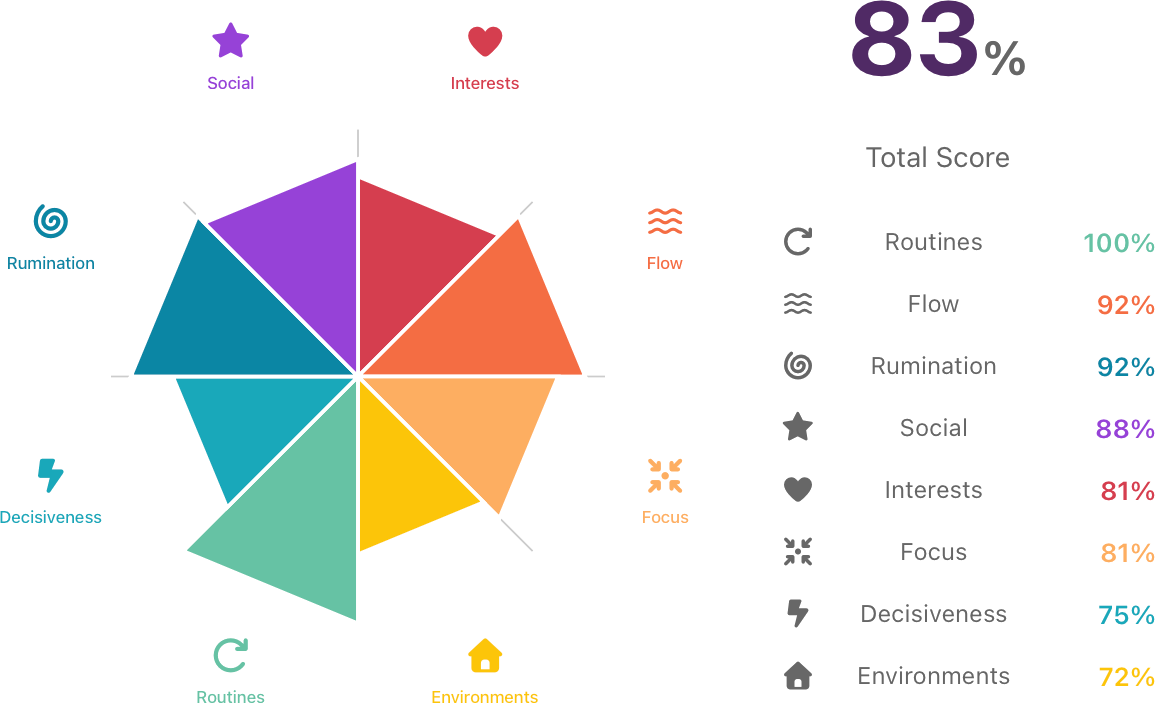
The Monotropism Questionnaire consists of 47 statements. You respond to each statement using a 1–5 scale, from strongly disagree to strongly agree. Your responses are grouped into eight dimensions that emerged from data analysis from the original research. These dimensions reflect different ways monotropic attention patterns can show up in everyday life for some people:
- Interests and Passions: Describes how your attention gathers around a few areas you care deeply about, and how consistently these interests organise your focus.
- Anxiety-Reducing Effect of Interests and Flow: Describes how immersing yourself in your interests can restore focus, ease tension, and support a sense of stability.
- Losing Track When Focused: Describes how attention can narrow so deeply that awareness of time, the body, or the wider environment fades into the background.
- Environmental Impact on Attention: Describes how sensory input, disruptions, or changes in your environment affect your ability to enter or maintain focus.
- Need for Routines: Describes how structure and predictability support your sense of stability and ability to focus.
- Decision-Making Difficulties: Describes how difficult it can feel to make choices when faced with multiple options, competing demands, or too much information at once.
- Rumination and Anxiety: Describes how easily your attention becomes caught in repeated loops of worry, unanswered questions, or thoughts that feel difficult to move on from.
- Managing Social Situations: Describes how navigating social situations can impact your attention, processing and overall energy.
- No Factor Items: Items that were not included in any dimensions.
References
- Murray, F., Lawson, W., Mery, P., 2022. Monotropism. monotropism.org.
- Garau, V., Murray, A., Woods, R., Chown, N., Hallett, S., Murray, F., Wood, R., Fletcher-Watson, S., 2023. Development and Validation of a Novel Self-Report Measure of Monotropism in Autistic and Non-Autistic People: The Monotropism Questionnaire.
- Edgar, H., 2023. Monotropism Questionnaire & Inner Autistic/ADHD Experiences. Autistic Realms.
- Heasman, B., Williams, G., Charura, D., Hamilton, L.G., Milton, D., Murray, F., 2024. Towards autistic flow theory: A non-pathologising conceptual approach. Journal for the Theory of Social Behaviour 54, 469–497. https://doi.org/10.1111/jtsb.12427
- Garau, V., Murray, A., Woods, R., Chown, N., Hallett, S., Murray, F., Wood, R., Fletcher-Watson, S., 2023. Development and Validation of a Novel Self-Report Measure of Monotropism in Autistic and Non-Autistic People: The Monotropism Questionnaire. Shared under Creative Commons Licence (CC BY-NC-SA).
- Murray, F., 2023. I’m monotropic… Now what?. monotropism.org.